Showing posts with label history. Show all posts
Thursday, September 03, 2015
The Chapel at Watson Lake, Yukon on the Alaska Highway
This old church in Watson Lake caught my eye. Known simply as "The Chapel", it's rustic persona blended well with the flavor of this portion of town. It is next to a gas station and motel, plus convenience store on the Alaska Highway in Watson Lake, Yukon.

I walked around The Chapel while Hubby pumped gas. The large lot in front of the building was easy to walk on, but the side and rear were a different story. Stick to the front of the building if you have mobility issues. That's where the interesting parts are anyway.
The young age of Watson Lake hit me when I read the sign in front of The Chapel.
Tuesday, October 28, 2014
Our visit to the USS North Carolina Battleship in Wilmington, NC
Wilmington, North Carolina is a quiet town in eastern North Carolina. It had a family atmosphere. We were drawn to it because of the beach and history attractions. My husband set his sights on going there the moment that he heard about the U.S.S. North Carolina Battleship in Wilmington.
Going on a cool day is important. Another visitor, who identified himself as a veteran, said that summer on a battleship can be hot. He was a friendly, chatty fellow who seemed to be an expert. Touring the USS North Carolina helped me appreciate the lives that the sailors lived. I still might not hesitate to visit during the summer, if that's when we could go.
Hours and prices can change, so be sure to check the website before arriving. It is open for tours daily and that includes holidays. http://www.battleshipnc.com/ Plan on eating before you go or use the picnic area. We didn't find anything nearby but the ship did have vending machines.
Let me also give a caution to people who have disabilities.
The U.S.S. North Carolina is a battleship, and cannot be made ADA compliant. If you have mobility issues, then pretty much everything except the upper deck is inaccessible. I didn't have much in the way of mobility issues then and was able to complete most of the self-guided tour.
Much of my time was spent most on the observation deck but I didn't feel cheated. The guns, Vought Kingfisher float plane, cannons and the indoor displays of photos and historic items were interesting. Chairs and a nice breeze made it a good place to wait for the rest of my family.
Inside the USS North Carolina are steep steps and a few fairly tight spaces. Good shoes are a must for secure footing. The battleship still smells of diesel in the lower parts of the ship. I wasn't expecting this and cannot imagine how overpowering the smell must have been for the men who lived and worked aboard the battleship.
If you are in reasonably good shape, and can climb, visiting the USS North Carolina Battleship is an amazing experience. Inside, you'll see portions of 9 decks and get a feel for every aspect of the lives of the people who served. There is the laundry, dark room, post office, newspaper, store, mess halls, sick bay, brig, and more.
At the end of the tour is the Wardroom. There you'll see a display of silver pieces. Near there is the Roll of Honor. This names the 10,000 North Carolinians who died in service during World War II.
If you are in Wilmington and are looking for something for your family to do give it a try. They recommend allowing at least two hours to visit the USS North Carolina. It took us three hours and was worth every minute and every penny.
Note: This article first appeared on Epinions in 2007.
| Battleship propeller USS North Carolina |
Hours and prices can change, so be sure to check the website before arriving. It is open for tours daily and that includes holidays. http://www.battleshipnc.com/ Plan on eating before you go or use the picnic area. We didn't find anything nearby but the ship did have vending machines.
Let me also give a caution to people who have disabilities.
The U.S.S. North Carolina is a battleship, and cannot be made ADA compliant. If you have mobility issues, then pretty much everything except the upper deck is inaccessible. I didn't have much in the way of mobility issues then and was able to complete most of the self-guided tour.
Much of my time was spent most on the observation deck but I didn't feel cheated. The guns, Vought Kingfisher float plane, cannons and the indoor displays of photos and historic items were interesting. Chairs and a nice breeze made it a good place to wait for the rest of my family.
Inside the USS North Carolina are steep steps and a few fairly tight spaces. Good shoes are a must for secure footing. The battleship still smells of diesel in the lower parts of the ship. I wasn't expecting this and cannot imagine how overpowering the smell must have been for the men who lived and worked aboard the battleship.
If you are in reasonably good shape, and can climb, visiting the USS North Carolina Battleship is an amazing experience. Inside, you'll see portions of 9 decks and get a feel for every aspect of the lives of the people who served. There is the laundry, dark room, post office, newspaper, store, mess halls, sick bay, brig, and more.
At the end of the tour is the Wardroom. There you'll see a display of silver pieces. Near there is the Roll of Honor. This names the 10,000 North Carolinians who died in service during World War II.
If you are in Wilmington and are looking for something for your family to do give it a try. They recommend allowing at least two hours to visit the USS North Carolina. It took us three hours and was worth every minute and every penny.
Note: This article first appeared on Epinions in 2007.
Thursday, May 15, 2014
Elijah Oliver Place stop 9 Cades Cove Loop
Nestled between the Old Cooper Road Trail and the Abrams Falls Hiking Trail on the Cades Cove Loop Road is the Elijah Oliver Place. It is at stop nine.
Bring your walking shoes and camera. People often think of pioneers living in single room cabins. Many families in Cades Cove lived in homes that had more than one room and several had more than one floor.
The Elijah Oliver Place is an example of a multi-room home. It sits about a half-mile off of the Cades Cove Loop Road.
Some of the buildings and their purposes at the Elijah Oliver Place include:
Elijah Oliver was born to parents John and Lucretia Oliver. Eiljah Oliver grew up in Cades Cove, left a few years before the Civil War and returned after the war to raise his family. The headstone of his parents is in the cemetery of the Cades Cove Primitive Baptist Church where Elijah Oliver served as a Deacon.
The Elijah Oliver Place is a historic example of a pioneer homestead. He had no way of knowing that the homestead he left behind would educate others for generations.
Bring your walking shoes and camera. People often think of pioneers living in single room cabins. Many families in Cades Cove lived in homes that had more than one room and several had more than one floor.The Elijah Oliver Place is an example of a multi-room home. It sits about a half-mile off of the Cades Cove Loop Road.
Some of the buildings and their purposes at the Elijah Oliver Place include:
- The cabin was a home for the family.
- A spring house provided the only refrigeration existed in 1865.
- Smokehouse was the place where meats were preserved by smoking the meat.
- Chicken coop and barn were for the nurturing and sheltering of animals.
- The corn crib was for storing corn and other vegetables.
Elijah Oliver was born to parents John and Lucretia Oliver. Eiljah Oliver grew up in Cades Cove, left a few years before the Civil War and returned after the war to raise his family. The headstone of his parents is in the cemetery of the Cades Cove Primitive Baptist Church where Elijah Oliver served as a Deacon.
The Elijah Oliver Place is a historic example of a pioneer homestead. He had no way of knowing that the homestead he left behind would educate others for generations.
Wednesday, January 22, 2014
Primitive Baptist Church on the Cades Cove Loop
Cades Cove Primitive Baptist Church is Stop 3 on your driving journey. It is one of three churches in the Cove. The other two are the Missionary Baptist Church and the Methodist Church. You'll find the driveway on the left about 1/2 mile or so from the John Oliver Place.
The Primitive Baptist Church sits off of Cades Cove Loop Road by less than a 1/2 mile. The roadway is narrow so be ready to yield to oncoming traffic if needed. The parking area accommodates several vehicles.. It's a quiet spot with plenty of space to explore the church and cemetery.
This congregation originally began as part of the Cades Cove Baptist Church that was established in 1827. A group left to found the Primitive Baptist Church in 1841. The building that you now see was erected in 1887. As you look behind the church, you will notice an old cemetery. It contains the graves of some of the earliest settlers of Cades Cove.
Like other churches, the congregation of the Primitive Baptist Church did not meet during the Civil War. As with the rest of the south, loyalties were sharply divided in the cove.
Your next stop will be at the Methodist Church. Go back out onto the road and turn on the one-way loop. The parking lot is directly on the loop road.
The Primitive Baptist Church sits off of Cades Cove Loop Road by less than a 1/2 mile. The roadway is narrow so be ready to yield to oncoming traffic if needed. The parking area accommodates several vehicles.. It's a quiet spot with plenty of space to explore the church and cemetery.
This congregation originally began as part of the Cades Cove Baptist Church that was established in 1827. A group left to found the Primitive Baptist Church in 1841. The building that you now see was erected in 1887. As you look behind the church, you will notice an old cemetery. It contains the graves of some of the earliest settlers of Cades Cove.
Like other churches, the congregation of the Primitive Baptist Church did not meet during the Civil War. As with the rest of the south, loyalties were sharply divided in the cove.
Your next stop will be at the Methodist Church. Go back out onto the road and turn on the one-way loop. The parking lot is directly on the loop road.
Saturday, January 04, 2014
Missionary Baptist Church Cades Cove on the loop road
Stop number six on the Cades Cove loop road is the Missionary Baptist Church. You will pass Rich Mountain Road on your right and Hyatt Lane on your left. Both of these are two way roads. The Missionary Baptist Church in Cades Cove is on your left. It sits directly on the road. You won't miss it.
History
A sign on the building tells you that the church was founded in 1839. The existing structure that visitors now see came about much later. Sources vary on the actual construction date.
Like the other churches in Cades Cove, the Missionary Baptist Church suffered during the Civil War. It was deemed too dangerous to gather at the church. Instead, smaller worship services were likely held in homes until after the war.
Features
Unlike some Baptist churches of the time, this one has a center aisle and one entrance door. A large bay window at the front of the church allows light in and adds beauty to the Cades Cove Missionary Baptist Church. The window made construction more difficult and is an unusual feature even today.
Cemetery
Visitors often enjoy strolling through the cemetery. Some of the first pioneers to Cades Cove are buried here. A path around the cemetery is marked. Visitors should stick to the approved walkway.
From here, we will continue on our journey to the Cooper Road Trail and the Elijah Oliver Place. In the meantime, if you missed it, you can go back and read about the Methodist Church in Cades Cove by clicking here.
A sign on the building tells you that the church was founded in 1839. The existing structure that visitors now see came about much later. Sources vary on the actual construction date.
Like the other churches in Cades Cove, the Missionary Baptist Church suffered during the Civil War. It was deemed too dangerous to gather at the church. Instead, smaller worship services were likely held in homes until after the war.
Features
Unlike some Baptist churches of the time, this one has a center aisle and one entrance door. A large bay window at the front of the church allows light in and adds beauty to the Cades Cove Missionary Baptist Church. The window made construction more difficult and is an unusual feature even today.
Cemetery
Visitors often enjoy strolling through the cemetery. Some of the first pioneers to Cades Cove are buried here. A path around the cemetery is marked. Visitors should stick to the approved walkway.
From here, we will continue on our journey to the Cooper Road Trail and the Elijah Oliver Place. In the meantime, if you missed it, you can go back and read about the Methodist Church in Cades Cove by clicking here.
Wednesday, October 09, 2013
Backstage tour of the Tennessee Theatre
Tennessee Theatre gave what I understood was a first-ever behind the scenes public look in honor of First Friday in Knoxville. It turns out that I was wrong. This tweet set the record straight.
@gaylecrabtree not true. The TT gave backstage tours to the public when it reopened after renovation, 1/16/2005. Over 5000 people there.
— Becky Hancock (@bupperoni) October 10, 2013
Eager participants lined up for the 5:30 p.m. tours. Visitors got to learn about the founding of the Tennessee Theatre and the incredible multi-million dollar renovation project.
We also found out about the variety of performances hosted today. From concerts to Broadway plays, the Tennessee Theatre seems to do it all.
The tour group that I was in was treated to a mini-organ concert on the Mighty Wurlitzer Organ. The organ is the pride of the theater for a reason. It is impossible to hear it and not be spellbound.
Organs like this one were marketed as a unit orchestra. This simply means that one organ was designed to replace an entire orchestra. A theatre need only hire one musician instead of dozens. Of the 2,000 that were sold only about 20 remain. Knoxville is truly fortunate to have one of them.
I can now say that I've been on stage at the Tennessee Theatre. We were allowed to stand there and look out over the auditorium. The next tour hadn't started yet so there was no audience to greet us. (Just my luck.)
I wish that I could say how many feet the renovation added to the stage but my place in the back of the group wasn't conducive to hearing everything. My guess-estimate from what I noted is that the stage is more than twice the size that it once was. The expansion allows a wider variety of acts to appear at the venue.
A wine tasting was offered as part of the tour and a music group played in the lobby. Hopefully, the Tennessee Theatre will offer a tour again. It was an absolutely splendid evening.
Bravo!
Updated 10/10/13 as stated above and to make a couple of edits.
Thursday, July 25, 2013
Fire Island Lighthouse and seashore vacation
Lighthouses are popular summer travel destinations because they offer something for the whole family. Our family interest in lighthouses began when my daughters were young. The first light that we visited was the
Fire Island Lighthouse on Captreee Island, New York. This is a barrier island that is just off of the coast of New York.
It has been operated by the (now dissolved) U.S. Lighthouse Service and then the U.S. Coast Guard. It was later declared to be inside the boundaries of the Fire Island National Seashore.
About a year before we visited in 1997, the care and upkeep of the lighthouse was transferred to the Fire Island Preservation Society through an agreement with the National Parks Service.
Did you know that the light is still listed as a privately maintained beacon on navigational maps?
It has been operated by the (now dissolved) U.S. Lighthouse Service and then the U.S. Coast Guard. It was later declared to be inside the boundaries of the Fire Island National Seashore.About a year before we visited in 1997, the care and upkeep of the lighthouse was transferred to the Fire Island Preservation Society through an agreement with the National Parks Service.
Did you know that the light is still listed as a privately maintained beacon on navigational maps?
Friday, April 05, 2013
Laura Clay marker at White Hall State Historic Site in Kentucky
The Laura Clay historic marker photographed here, commemorates her devotion to women's rights. As the daughter of Russia Ambassador Cassius M. Clay, Laura grew up with a bird's-eye view of politics in action. She watched her father found the Republican Party and saw its impact on the political arena. Later, she would be the first woman to be nominated to run for president by a major political party.

There is no doubt that Laura was impacted by her upbringing. Born in 1849, she worked throughout her life to further the cause of women's rights. Her accomplishments included coeducation property and joint guardianship rights for women in Kentucky.
The Laura Clay historic marker at White Hall State Historic Site outlines her life of service.
There is no doubt that Laura was impacted by her upbringing. Born in 1849, she worked throughout her life to further the cause of women's rights. Her accomplishments included coeducation property and joint guardianship rights for women in Kentucky.
The Laura Clay historic marker at White Hall State Historic Site outlines her life of service.
Monday, February 18, 2013
Paris, Kentucky CSA historic marker iand points of interest
Paris, Kentucky is a small town with an interesting history. This CSA historical marker in Paris only tells part of the story and other points of interest draw visitors. During the Civil War, Kentucky planned to remain neutral but neither the CSA or Union Forces got the memo. A plea for help from Kentucky leadership put the state solidly under Union control not long after the war began.
Although I originally came for a wedding, it only seemed right to explore points of interest. After all, Paris is only 20 minutes from Lexington and is in the heart of the famed (and beautiful) Kentucky Bluegrass region.
This CSA historical marker in Paris is one point of interest that captured my attention. On July 18, 1862, the General John Hunt Morgan on 1st Kentucky raid came into town after victory in Cynthiana.
After being warned that Union troops were nearby the CSA escaped. While Confederates held Lexington and two other cities, they occupied Paris, Kentucky for three weeks.
Today, you shouldn't escape from Paris without stopping in the historic downtown area.
Although I originally came for a wedding, it only seemed right to explore points of interest. After all, Paris is only 20 minutes from Lexington and is in the heart of the famed (and beautiful) Kentucky Bluegrass region.This CSA historical marker in Paris is one point of interest that captured my attention. On July 18, 1862, the General John Hunt Morgan on 1st Kentucky raid came into town after victory in Cynthiana.
After being warned that Union troops were nearby the CSA escaped. While Confederates held Lexington and two other cities, they occupied Paris, Kentucky for three weeks.
Today, you shouldn't escape from Paris without stopping in the historic downtown area.
Saturday, January 26, 2013
Daniel Boone National Forest is on my to do list
Daniel Boone is a legend among legends. His name conjures up images of mountain men blazing trails through forests and of the Boonesboro settlement. The Daniel Boone National Forest in Kentucky is the only place that is perhaps bigger than legends of the man himself.
The forest covers 708,000 acres of land west of the Appalachian Mountains. The office in London, Kentucky is easy to find. It is on the main artery through town. To help you recognize it, I have a photo on RedGage.
My daughter and I were in the Daniel Boone National Forest when we visited Camp Wildcat near Wilderness Road. The forest is fairly accessible from Berea, Richmond and has an office in London. Each of these towns are on I-75. Highway 25 out of LaFollette follows Wilderness Road which goes through parts of the forest.
Hikers will be happy to know that there are over 600 miles of trails and roads to be explored. Daniel Boone National Forest is home
to the The Sheltowee Trace National Recreation Trail.
One of the trailheads is in Big South Fork in Tennessee. Then the trail goes into Kentucky past Cumberland Falls, Natural Bridge, Pickett State Park and Red River Gorge. Only a few miles from the terminus in Kentucky, hikers can connect with the Jenny Wiley Trail and head into Ohio.
Daniel Boone National Forest has all of the activities that you would expect to find. Fishing is available at Cave Run Lake and Laurel River Lake. Plus there are plenty of other creeks and streams. A Kentucky fishing license is required.
Camping within the Daniel Boone National Forest is on my list of things to do. It looks like summer is going to be busy. I look forward to Cumberland Falls and revisiting Camp Wildcat.
| Sheltowee Trace marker |
My daughter and I were in the Daniel Boone National Forest when we visited Camp Wildcat near Wilderness Road. The forest is fairly accessible from Berea, Richmond and has an office in London. Each of these towns are on I-75. Highway 25 out of LaFollette follows Wilderness Road which goes through parts of the forest.
Hikers will be happy to know that there are over 600 miles of trails and roads to be explored. Daniel Boone National Forest is home
to the The Sheltowee Trace National Recreation Trail.
One of the trailheads is in Big South Fork in Tennessee. Then the trail goes into Kentucky past Cumberland Falls, Natural Bridge, Pickett State Park and Red River Gorge. Only a few miles from the terminus in Kentucky, hikers can connect with the Jenny Wiley Trail and head into Ohio.
Daniel Boone National Forest has all of the activities that you would expect to find. Fishing is available at Cave Run Lake and Laurel River Lake. Plus there are plenty of other creeks and streams. A Kentucky fishing license is required.
Camping within the Daniel Boone National Forest is on my list of things to do. It looks like summer is going to be busy. I look forward to Cumberland Falls and revisiting Camp Wildcat.
Tuesday, January 22, 2013
Overmountain Victory Trail Auto Route; Battle of Kings Mountain
The Overmountain Victory Trail signs that we saw on Roan Mountain State Park in Tennessee and at Sycamore Shoals piqued my interest. This auto tour (commemorative motor route) was new to me. You know how I am. It was time to see where Overmountain Victory Trails signs would lead.
Rangers at the Sycamore Shoals Visitor Center filled me in on some details. We were on part of a National Historic Trail that covers portions of Tennessee, North Carolina, South Carolina and Virginia.
The road trip begins in Abdington, Virginia and ends in South Carolina. Here is the history behind the motor route.
In 1780, a plea for help was issued from Kings Mountain in South Carolina. American loyalist forces who supported the crown were on the move. The patriots needed help and needed it quickly.
When the call arrived it answered by "overmountain men" from Tennessee, Virginia and North Carolina. All of the patriots left fields, livestock, homes and family to answer the call.
Patriots forces were outnumbered, outgunned and out trained.
![]() |
| Overmountain Victory Trail Sign |
The road trip begins in Abdington, Virginia and ends in South Carolina. Here is the history behind the motor route.
In 1780, a plea for help was issued from Kings Mountain in South Carolina. American loyalist forces who supported the crown were on the move. The patriots needed help and needed it quickly.
When the call arrived it answered by "overmountain men" from Tennessee, Virginia and North Carolina. All of the patriots left fields, livestock, homes and family to answer the call.
Patriots forces were outnumbered, outgunned and out trained.
Monday, January 14, 2013
Sycamore Shoals State Park is your chance to see living history
Most people refer to Sycamore Shoals as a park but it is actually a state historic area. Its title was earned because of the historic on U.S. History and also the State of Tennessee.
The park was packed when we got there. My husband pulled up to the Sycamore Shoals State Historic Area where my daughter and I got out. That's when we heard the first "Boom!". Another loud burst came immediately. My husband yelled "Yay! A reenactment!" so we hurried out of the car as fast as we could.
| Sycamore Shoals park sign |
This is home to the first settlement that was developed after the original 13 colonies. Sycamore Shoals State Historic Area is home to the Watauga Association. This group created the first written constitution outside of the colonies and it is where the Transylvania Purchase (also called the Treaty of Sycamore Shoals) was signed. Click here for park photos and to
Sunday, January 13, 2013
Roan Mountain State Park Campground is a great camping trip
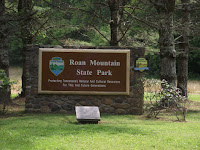
Roan Mountain State Park Campground in Tennessee is one of the better state park campgrounds that we have stayed in so far. A clean, well maintained camping area is important but so is friendly staff. Roan Mountain State Park campground has the power packed combination of both.
We got there by taking I-26 to Johnson City. From there, you go through town and take the Elizabethton / Roan Mountain State Park exit onto Hwy. 67.
From there it was just a matter of following the signs. The campground is at the base of the mountain and within an easy drive of Elizabethton and Carver's Gap.
The 87 RV sites have electric and water hook-ups. Every site has a grill and a picnic table. They are available on a first come, first served basis. My family was there during the week in late May and we had no problems finding a well shaded, quiet site on a loop.
Our nearest neighbors came in on Friday night. They were several sites away and downhill from us. Until then, we had the entire half loop to ourselves. Roan Mountain State Park campground also has tent sites. They do not have electricity but there are shared water spigots.
Roan Mountain State Park has inviting cabins with wide front porches. We may try one of those next time. Depending on which you want, you can book
| Roan Mountain State Park sign |
The 87 RV sites have electric and water hook-ups. Every site has a grill and a picnic table. They are available on a first come, first served basis. My family was there during the week in late May and we had no problems finding a well shaded, quiet site on a loop.
Our nearest neighbors came in on Friday night. They were several sites away and downhill from us. Until then, we had the entire half loop to ourselves. Roan Mountain State Park campground also has tent sites. They do not have electricity but there are shared water spigots.
Roan Mountain State Park has inviting cabins with wide front porches. We may try one of those next time. Depending on which you want, you can book
Tuesday, January 08, 2013
Roaring Fork Motor Nature Trail: the Smokies best kept secret
The Roaring Fork Nature Trail may be the Smokies best kept secret. When you ask someone what their favorite auto drive is in the Great Smoky Mountains National Park, the answer is almost always the Cades Cove Loop Road. A few people will mention the Newfound Gap Road (U.S. 441) from Sugarlands to Oconoluftee. However; the Roaring Fork Nature Trail rarely comes up and that's a shame.
Roaring Fork reminds me of a forested, scaled down version of the Cades Cove loop road. The auto tour is scattered with very log cabins and grist mills.
The historic structures bring you back to the early days of Southern Appalachia and the route is home to, the swiftest stream in the Smokies. Hikes can lead you to some of the most stunning waterfalls in the park. There are always wildflowers in the spring, foliage in the fall and the chance to see wildlife.
One of my favorite places on the route is the "Place of 1,000 Drips". Tons of very tiny waterfalls cascade down the hillside and the road goes right up to it.
Make no mistake. This isn't Grotto Falls and
it isn't Rainbow Falls. The special charm of the "Place of 1,000 Drips" is a good spot to walk around or take photos.
The Roaring Fork Nature Trail is a six mile, one-way loop. If you leave Gatlinburg after lunch, then you will be back in time for dinner with time to spare. Of course, you may want to add extra time for hiking or taking photos.
If you are going to Gatlinburg, then driving it is a snap. Take the main parkway into Gatlinburg and turn at traffic light #8. From there, it's just a matter of following the signs. The trail entrance is just beyond the trailhead for Rainbow Falls. (Even I couldn't miss the entrance.)
Helpful hints
Roaring Fork reminds me of a forested, scaled down version of the Cades Cove loop road. The auto tour is scattered with very log cabins and grist mills.
The historic structures bring you back to the early days of Southern Appalachia and the route is home to, the swiftest stream in the Smokies. Hikes can lead you to some of the most stunning waterfalls in the park. There are always wildflowers in the spring, foliage in the fall and the chance to see wildlife.
One of my favorite places on the route is the "Place of 1,000 Drips". Tons of very tiny waterfalls cascade down the hillside and the road goes right up to it.Make no mistake. This isn't Grotto Falls and
it isn't Rainbow Falls. The special charm of the "Place of 1,000 Drips" is a good spot to walk around or take photos.
The Roaring Fork Nature Trail is a six mile, one-way loop. If you leave Gatlinburg after lunch, then you will be back in time for dinner with time to spare. Of course, you may want to add extra time for hiking or taking photos.
If you are going to Gatlinburg, then driving it is a snap. Take the main parkway into Gatlinburg and turn at traffic light #8. From there, it's just a matter of following the signs. The trail entrance is just beyond the trailhead for Rainbow Falls. (Even I couldn't miss the entrance.)
Helpful hints
Saturday, October 27, 2012
Red Clay stories from my grandfather
The Trail of Tears National Historic Trail has always held a sad fascination for me. I grew up hearing tales of Red Clay (before it became a state historic park) and John
Ross. Red Clay State Historic Park is in the extreme southwest portion of
Bradley County, Tennessee along the Georgia state line.
Growing up, my family visited what is
now Red Clay State Park many times. One of the key features of this Trail of Tears site is the deep Blue Hole Springs. On each visit to the park, my grandfather
would tell me that this Blue Hole Springs (one of several in the area) was special.
According to him, the Cherokee Indians had to carry their belongings on the Trail of Tears. He said that they could not carry was supposedly thrown into the spring. In this way, the items would be protected from the white Europeans even if lost forever by the Cherokee.
I always asked about the depth of the spring at Red Clay. He was fond of saying that the bottom was never found. My grandfather said that later, men in the community gathered all the rope that they could find. A heavy old stove was tied to the rope and hoisted into the stream. I was told that no matter how they tried, the stove never hit bottom.
A national trail has been developed to
approximate
the routes that were used. The nine states that are included in the
Trail of Tears National Historic Trail include North Carolina,
Georgia, Tennessee, Alabama, Kentucky, Illinois, Oklahoma, Missouri
and Arkansas. A Trail of Tears map was created by the National Park
Service and is online at thislink.
![]() |
| Blue Hole Spring at Red Clay |
According to him, the Cherokee Indians had to carry their belongings on the Trail of Tears. He said that they could not carry was supposedly thrown into the spring. In this way, the items would be protected from the white Europeans even if lost forever by the Cherokee.
I always asked about the depth of the spring at Red Clay. He was fond of saying that the bottom was never found. My grandfather said that later, men in the community gathered all the rope that they could find. A heavy old stove was tied to the rope and hoisted into the stream. I was told that no matter how they tried, the stove never hit bottom.
A cool creek still runs from the mouth
of the stream. My grandfather told me stories of cooling watermelons
in the water. He also talked to me about the peaches, corn and other
crops that grew well in the surrounding lands.
Eventually, the stories always turned
to the Trail of Tears and he would become sad. The site of Red Clay State Historic area is
the geographical beginning of one of the most tragic events in U.S.
History.
Tension between the whites and Native
Americans had been growing for years before the removal. The tensions
were primarily over lands and the discovery of gold in Dahlonega,
Georgia. Other factors were probably also involved. In 1830, the
Indian Removal Act was passed that allow the government to forcibly
relocate Native American Indians from their ancestral homes to lands
in the west.
The Choctaw Nation was the first to be
moved in 1831. The Seminole, Creek, Chickasaw nations followed soon
after. Some of the groups were moved by treaty but others, like the
Cherokee would take their case to court. Those efforts would prove
futile.
The Trail of Tears would begin in the
winter of 1838. Red Clay is the final tribal council ground of the
Cherokee. It was here that that word of the removal was received. The
people would be moved during what would become one of the harshest
winters on record.
Frozen ground yields little in terms of
water or the small game that larger animals depend upon. Hunting and
foraging produced minimum results. One fourth of the Cherokee who
began their journey from Red Clay would not live to see Oklahoma.
![]() |
| Green fields of Red Clay State Park |
A marker at the Cherokee Removal
Memorial Park tells us that the Trail of Tears was named for those
who died, and cried on the journey westward. The journey would be
forever known as the Trail of Tears.
There is some doubt as to the accuracy of each of the stories. Some, like the watermelon story, I know to be true. I have eaten from cool watermelons that were placed in the creek from Blue Hole Spring. There is no doubt that Red Clay was a tribal council ground. Everything else is subject to interpretation and has become part of the lore of the area.
Read more of my articles about the Cherokee Removal Memorial Park and Three National Trail of Tears historic sites in Tennessee. At
the end of the day the stories of watermelons are not important. What
matters is the people who walked, cried and were lost on the Trail of
Tears that began at Red Clay.
Thursday, October 25, 2012
Blythe Ferry Trail of Tears historic site near Dayton, Tennessee
The Cherokee Removal Memorial at Blythe Ferry is not far from Dayton, Tennessee. Beginning in September 1838, the forced removal of the Cherokee began. Almost 10,000 Cherokee in nine detachments were moved through Blythe
Ferry on the way to parts west. Many of these people would perish on
their westward journey.
As this map indicates, Cherokee Removal Memorial Park is tucked away near Dayton and is close to the confluence of the Tennessee and the Hiwassee Rivers. To get there, we took I-75 exit 27 and turned right onto Hwy. 60. The road winds and twists but Blythe Ferry is about 10 miles ahead. We saw the sign pretty clearly as we drew near to the entrance.
The Blythe Ferry site is on the shore of the Hiwassee River. The warm weather and nearly cloudless sky were ideal for a visit to the Cherokee Removal Memorial Park but, there was one disappointment. The visitor center was closed.
As this map indicates, Cherokee Removal Memorial Park is tucked away near Dayton and is close to the confluence of the Tennessee and the Hiwassee Rivers. To get there, we took I-75 exit 27 and turned right onto Hwy. 60. The road winds and twists but Blythe Ferry is about 10 miles ahead. We saw the sign pretty clearly as we drew near to the entrance.
The Blythe Ferry site is on the shore of the Hiwassee River. The warm weather and nearly cloudless sky were ideal for a visit to the Cherokee Removal Memorial Park but, there was one disappointment. The visitor center was closed.
Sunday, August 12, 2012
Assembly Street historic marker in Columbia, SC
This Assembly Street historic marker in Columbia, South Carolina was nestled behind roadside shrubbery. Taking a minute to stop at the markers help bring the history of a city to life. There are over 1,300 of them in South Carolina. Every city that I have traveled to has had sections with fascinating backgrounds. I hated history in high school. Now that I can travel more frequently, it's the past that intrigues me about most places.
Not all of the markers are easy to get to and you don't want to have to test out your car insurance. When stopping, be careful to watch for traffic or other conditions that can make reading the markers dangerous. Shrubbery and traffic made the Assembly Street marker in Columbia a challenge to get to.
Assembly Street was one of the two principle thoroughfares through Columbia. The road was named for the first General Assembly that met in 1790 in the new State House of South Carolina.
A nearby marker designates where the State House once stood. This map lists the South Carolina Veterans Memorial and other points of interest. If you are traveling through, it can be fun to visit some of these sites. Here are a few other places that might interest you.
Chestnut Cottage Columbia, South Carolina
General Maxcy Gregg birthplace marker; Columbia, South Carolina
Historic Trinity Episcopal Church in Columbia, South Carolina
Assembly Street was one of the two principle thoroughfares through Columbia. The road was named for the first General Assembly that met in 1790 in the new State House of South Carolina.
A nearby marker designates where the State House once stood. This map lists the South Carolina Veterans Memorial and other points of interest. If you are traveling through, it can be fun to visit some of these sites. Here are a few other places that might interest you.
Chestnut Cottage Columbia, South Carolina
General Maxcy Gregg birthplace marker; Columbia, South Carolina
Historic Trinity Episcopal Church in Columbia, South Carolina
Monday, August 06, 2012
Chestnut Cottage Columbia, South Carolina
Chestnut Cottage in Columbia, South Carolina was another historic stop that we spotted on our walk. The marker indicates that it was temporarily the home of General and Mrs. James Chestnut. It was here that Mary Boykin Chesnut penned A Diary From Dixie.The book is widely considered to be one of the finest literary works of the Civil War.
The Chestnuts were known for their hospitality to the Confederacy elite. One of the groups to have taken advantage of the hospitality was the Confederate President Jefferson Davis (to whom Mrs. Chestnut served as an aide) and his staff.
It was upon the steps of the circa 1850 house that Confederate President Jefferson Davis addressed the citizens of Columbia, South Carolina.
The Chestnut Cottage is now a unique bed and breakfast. Period antiques and Civil War artifacts are key features of the inn. It is at 1718 Hampton Street in Columbia, South Carolina.
The street itself is wide, tree lined and proved to be a good place for an afternoon stroll.
Other historic sites and markers that we enjoyed are:
Confederate printing plant marker in historic Columbia, SC
General Maxcy Gregg birthplace marker; Columbia, South Carolina
Confederate printing plant marker in historic Columbia, SC
| Chestnut Cottage historic marker |
It was upon the steps of the circa 1850 house that Confederate President Jefferson Davis addressed the citizens of Columbia, South Carolina.
| Chestnut Cottage |
The street itself is wide, tree lined and proved to be a good place for an afternoon stroll.
Other historic sites and markers that we enjoyed are:
General Maxcy Gregg birthplace marker; Columbia, South Carolina
Confederate printing plant marker in historic Columbia, SC
Saturday, August 04, 2012
Historic Trinity Episcopal Church in Columbia, South Carolina
One of the most impressive structures in Columbia, South Carolina is the historic Trinity Episcopal Church. It is the oldest surviving sanctuary in the city. It was placed on the National Register of Historic Places in 1971. The structure is impressive.
Standing in front of it, I could not help but feel that you are on the front steps of God's house. It was impossible for us to walk away without being in awe of the faith of those who carefully created this inspiring structure.
It now goes by the name of Trinity Episcopal Cathedral. You can find it on Sumter Street between Gervais and Senate Streets. I was pleasantly surprised to find that it is still an active worship center in Columbia. With a nod to modern technology, sermons can be downloaded online. The schedule for services at Trinity Episcopal Cathedral are also on the church website.
It is interesting to note that this impressive structure survived the Civil War. This was one of a handful of buildings that was not burned by Union Soldiers under the command of General Sherman. The history of Trinity Episcopal Cathedral records that the rectory and other buildings were lost but the main building was spared. Perhaps it's imposing presence touched the soul of one of the most feared leaders of the Civil War?
The historic cemetery is adjacent to the church. It is the final resting place of congressmen, Confederate soldiers, common people, Revolutionary War heroes and other leaders.
Hubby and I were able to stroll the sidewalk in front of the church and the grounds. Hopefully, next time we'll be able to join the congregation in worship.
Other articles that you may enjoy include the General Maxcy Gregg birthplace marker. This commemorates the birthplace of one of the Confederate generals. Another article is my choices for the Top road trip drives in the South. It is suggested reading for anyone who wants to more fully explore this area of the country.
It now goes by the name of Trinity Episcopal Cathedral. You can find it on Sumter Street between Gervais and Senate Streets. I was pleasantly surprised to find that it is still an active worship center in Columbia. With a nod to modern technology, sermons can be downloaded online. The schedule for services at Trinity Episcopal Cathedral are also on the church website.
It is interesting to note that this impressive structure survived the Civil War. This was one of a handful of buildings that was not burned by Union Soldiers under the command of General Sherman. The history of Trinity Episcopal Cathedral records that the rectory and other buildings were lost but the main building was spared. Perhaps it's imposing presence touched the soul of one of the most feared leaders of the Civil War?
The historic cemetery is adjacent to the church. It is the final resting place of congressmen, Confederate soldiers, common people, Revolutionary War heroes and other leaders.
Hubby and I were able to stroll the sidewalk in front of the church and the grounds. Hopefully, next time we'll be able to join the congregation in worship.
Other articles that you may enjoy include the General Maxcy Gregg birthplace marker. This commemorates the birthplace of one of the Confederate generals. Another article is my choices for the Top road trip drives in the South. It is suggested reading for anyone who wants to more fully explore this area of the country.
Wednesday, May 09, 2012
Confederate printing plant marker in historic Columbia, SC
Civil War history always in Columbia includes the Confederate printing plant marker. It may surprise you to know that during the Civil War both sides circulated their own currency. This is one of the traits of any country.
After declaring independence one of the first things that the Confederacy had to do was to mint their own currency. One of the places that they did that was at the priniting plant in Columbia, South Carolina.
The Historic Marker Database tells us that the marker was placed by the Mary Boykin Chesnut Chapter No. 2517, United Daughters of the Confederacy. It is number 40-124.
There are at least eight other Civil War markers in the historic area of Columbia. The best way to see them all is to spend an hour or so and take the self-guided walking tour of historic Columbia.
For almost a year, the Confederate Printing Plant produced Confederate currency was printed here throughout the Civil War by the firm of Evans and Cogswell. Currency was printed here from April 1864 to February 1865 when it was burned during the General Sherman occupancy in Columbia.
The long brick building covers a city block. It was rebuilt after the Civil War and served several different purposes. It was placed on the National Register of Historic Places in 1979 to commemorate the role of the building as the Confederate printing plant.
Reading the marker and looking up at the building was a little surreal. In blending of past and present, this Civil War era building now houses a Publix grocery store. Shopping here puts you in the footsteps of history. That alone makes shopping here the most unique experience that I know about.
Carolina fence garden at the SC welcome center
The Historic Marker Database tells us that the marker was placed by the Mary Boykin Chesnut Chapter No. 2517, United Daughters of the Confederacy. It is number 40-124.
There are at least eight other Civil War markers in the historic area of Columbia. The best way to see them all is to spend an hour or so and take the self-guided walking tour of historic Columbia.
For almost a year, the Confederate Printing Plant produced Confederate currency was printed here throughout the Civil War by the firm of Evans and Cogswell. Currency was printed here from April 1864 to February 1865 when it was burned during the General Sherman occupancy in Columbia.
The long brick building covers a city block. It was rebuilt after the Civil War and served several different purposes. It was placed on the National Register of Historic Places in 1979 to commemorate the role of the building as the Confederate printing plant.
Reading the marker and looking up at the building was a little surreal. In blending of past and present, this Civil War era building now houses a Publix grocery store. Shopping here puts you in the footsteps of history. That alone makes shopping here the most unique experience that I know about.
Carolina fence garden at the SC welcome center
Subscribe to:
Posts (Atom)

.jpg)

.jpg)
.jpg)
.jpg)